


Redefining the boundaries for plumbing and heating professionals
An ongoing transformation is taking place within the plumbing and heating market as contractors react to new opportunities within the ever-evolving heating sector. As the sustainability agenda continues to drive change, boundaries between trades are becoming blurred.
Mike Lucken, Conex Bänninger’s Technical Sales Manager – ACR, examines the continuing changes within the industry and why increasing numbers of installers and contractors are widening their knowledge base and skills, to adopt a multi-disciplinary approach.
The march towards Net Zero by 2050 has been instrumental in the changes that have taken place within the building and construction sectors as energy performance emerged as a key priority, whether retrofitting buildings with energy efficient systems, or incorporating them at the design stage of new properties.
Under the proposed Future Homes Standard, which is planned to come into force in March 2027, new homes will need to be highly energy efficient requiring developers to install heat pumps or link properties to heat networks instead of using gas boilers. This means gas boilers will effectively be prohibited on new homes after that date. (A previously muted ban of 2035 for the fitting of gas boilers in existing homes was cancelled and no future date for this exists).
Today’s modern homes are equipped with appliances and technology features that combine electrical wizardry with practical solutions for comfort living. Sustainability extends to the type of eco-friendly materials used, through to efficient heating systems that provide all year-round controllable temperature. Occupants benefit from highly efficient HVAC systems which regulate internal temperature; and are well insulated throughout to keep the warm in and the cold out.
The work of a traditional boiler installer is evolving – and many are now getting to grips with such areas as refrigeration cycles, system balancing and air handling; whilst HVAC contractors are also expanding their services to become more familiar with domestic hot water and hydronic systems used in modern underfloor heating, radiators and chilled-water air conditioning,
New era – new rules
In today’s smart homes, there is a requirement to connect several elements – heating, cooling, hot water, ventilation and energy management systems. Rather than turning to several trade professionals, homeowners would prefer just one or two contractors to carry the work out.
The introduction of heat pumps dissects plumbing, heating and HVAC areas and this creates a growing market opportunity for heating contractors considering a move into an area that was previously dominated by HVAC specialists. Whilst some trade professionals will continue to stick to what they know, others are recognising the benefits of being able to fit heat pumps and the accompanying pipework.
Given their transferable skills, increasing numbers of heating contractors are taking advantage of the opportunities that exist within the heating and air conditioning industry by broadening their knowledge base and skills. To do this, F-Gas certification is required to handle refrigerants or install and service air conditioning units within the UK. This market is strictly regulated, and merchants won’t supply refrigeration products without proof of F-Gas accreditation.
It is vital that installers know how to purge an air conditioning system correctly to ensure oxygen is displaced from the system, preventing the oxidation which can lead to compressor failure. There are numerous air conditioning industry courses and diplomas that are available, as well as some manufacturers offering ‘hands-on’ training.
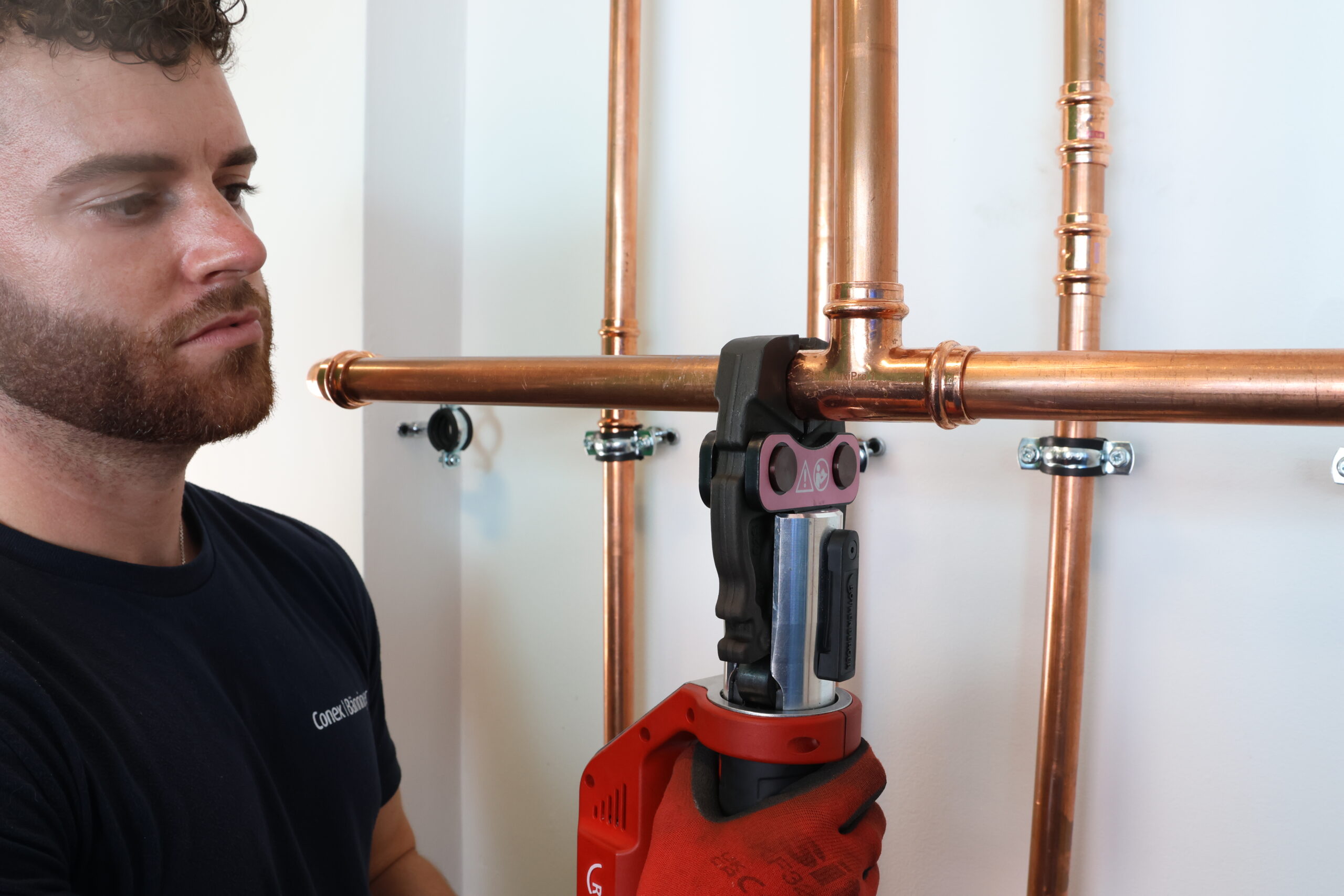
When I provided training to air conditioning apprentices at the City of Liverpool College on how to install >B< MaxiPro, the tutors also asked me to demonstrate the >B< MaxiPro system to plumbing and heating apprentices. This was, I felt, an indication of the college recognising changing working practices.
Conex Bänninger has developed an extensive product range for the ACR market which includes the market leading >B< MaxiPro, that has revolutionised pipe-jointing in air conditioning and refrigeration applications. This flame-free press fitting was specifically designed for air conditioning and refrigeration applications and comes in sizes from ¼” up to 1 5/8”. It is compatible with widely used refrigerants including: HFC refrigerants such as R404A, R410A and R32, HFO refrigerants including R1234YF and Hydrocarbon refrigerants such as R290 (propane).
Looking ahead
Whilst there is no future date in place for banning the installation of gas boilers in existing homes, it will certainly happen at some point in the future. Like all new technologies, the price of heat pumps and eco-related products may fall with wider adoption. However, until costs reduce considerably, the average householder remains unable or unwilling to afford heat pump technology.
Whilst the housing market is currently in the doldrums, once confidence in the economy improves and mortgage rates fall, we should see more housebuilding taking place. Given the requirement for smart homes technology, and the current skills shortage, this should encourage more heating installers to broaden their training base working and crossover into the HVAC market.
Related News
News
07 Aug 2026
Stainless steel systems deliver durability and performance
News
03 Aug 2026
InstallerSHOW proves a resounding success for Conex Bänninger
News
11 May 2026